 After Supper
Two of This Powder's Three Ingredients Come From the Coffee and Tea Plants
Focus and Memory Mushrooms is half a teaspoon of powder from Laird Superfood in Oregon. I sat at the evening table with my coffee tin and my tea caddy and worked out what the scoop adds to each cup.

This is a paid advertisement. Sponsored by Laird Superfood, Inc.

Hugh Barlow is the pen name of this desk, and the household in these pages is a composite.
Everything about the pouch comes from the seller's own product page, the photographs of its label, and its shipping and return pages.
The customers quoted further down are real, and their words are public on the seller's own page.
The small pictures beside them are illustrations, not the reviewers.
Supper is over at our house by half past six.
The plates go into the sink, the lamp over the table goes on, and whatever came in the mail that day gets opened there.
That is the evening table.
It is where the bills get paid, where the crossword gets finished, and where anything new that comes into the kitchen gets looked over before it earns a place in the cupboard.
Last week a blue pouch came to the table.
My brother-in-law had left it with us after a visit, half used, with a small plastic scoop inside.
He had one question about it, and he asked it on the phone the next day.
"Does it go in coffee or in tea?"
It sounded like a small question. It turned out to be the whole story of the pouch.
The label answers it quickly.
Coffee, tea or a smoothie, half a teaspoon, mixed well, stirred as you sip.
But I wanted to know what the half teaspoon actually adds to each of those cups.
So I did what I always do at the evening table: I put the new thing beside the old things and read them together.
The coffee tin came down from the shelf.
The tea caddy came down beside it.
And the blue pouch went between them, which turned out to be exactly where it belongs.
Two of its three ingredients come from the same two plants as the tin and the caddy.
One is the fruit of the coffee plant, the red cherry that grows around the bean.
The other is L-theanine, an amino acid the label says was taken from green tea.
Only the third ingredient is new to my cupboard.
That is lion's mane, an edible mushroom, grown for this pouch on a bed of oats.
So the question my brother-in-law asked was the right one, and the answer is different for a coffee drinker than for a tea drinker.
In a cup of coffee, the pouch adds the fruit of the plant you are already drinking, along with its caffeine, plus a tea amino acid and a mushroom.
In a cup of tea, it adds more of an amino acid the leaf already carries, plus a coffee fruit with its caffeine, and the same mushroom.
Either way, the mushroom is the one ingredient you would not have had without the pouch.
And the mushroom is also the one whose research used far more than any half teaspoon could hold.
That is the shape of it.
The rest of this page is the working, cup by cup, and it takes a while.
It takes a while because none of the three is printed with its own amount.
The label gives one number, 1.3 grams, for all three together.
And it takes a while because the most useful thing I found at the evening table was not in the pouch at all.
It was on the plate, and I will get to it before the end.
A Coffee Tin, a Tea Caddy and a Blue Pouch
Most kitchens I know have two shelves of habit.
One holds the coffee, the other holds the tea, and the man of the house usually belongs to one of them.
I belong to both.
Coffee in the morning, black, one mug, before anyone else is up.
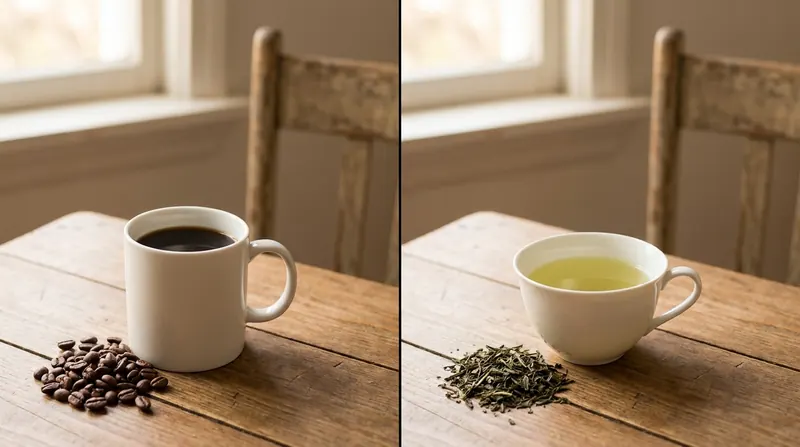
Tea in the afternoon, green in summer and black in winter, usually around three.
My wife drinks tea all day and has never understood the coffee.
So when the pouch came to the table, the first thing I noticed was that it belonged to both shelves at once.
It carries a piece of the coffee plant and a piece of the tea plant, and a mushroom from somewhere else entirely.
Here is the ingredient line, as the panel prints it.
A "Focus and Memory Blend" of 1.3 grams per half teaspoon.
Inside that blend, three names.
Organic lion's mane mushroom, mycelium and fruiting bodies grown on organic oats; L-theanine, sold under the name L-TeaActive, from green tea; and coffee berry, the whole fruit of the arabica coffee plant, dried and powdered.
Nothing else is listed.
No sweetener, no flavor, no carrier.
Three plants, one number, and two of them are plants you have been drinking for most of your life.
I want to take them one at a time, in the order they would reach you if you stirred the pouch into your usual cup.
First the coffee fruit, because it brings the caffeine.
Then the tea amino acid, because it is the half of a famous pairing.
Then the mushroom, because it is the only stranger at the table.
And after that, the two cups side by side: what the half teaspoon changes in a mug of coffee, and what it changes in a cup of tea.
That comparison is the reason this page exists.
One thing first, so there is no confusion later.
I am not going to tell you how much of each ingredient is in a scoop, because nobody outside the company can.
The panel prints 1.3 grams for the whole blend.
Any figure you see for one ingredient alone is a guess, and I will not make one.
The Fruit That Grows Around the Coffee Bean

Most coffee drinkers have never seen the fruit their coffee comes from.
I hadn't, until a trip years ago, and it surprised me.
A coffee bean is a seed.
It grows inside a small round fruit that turns from green to red as it ripens, and people call it a coffee cherry.
For most of coffee's history, the fruit has been the part people threw away.
The beans are taken out, washed, dried and roasted, and the red pulp around them is left behind.
Not everywhere.
In Yemen and in Bolivia, the dried husk of the fruit has long been steeped as a drink of its own, called cascara.
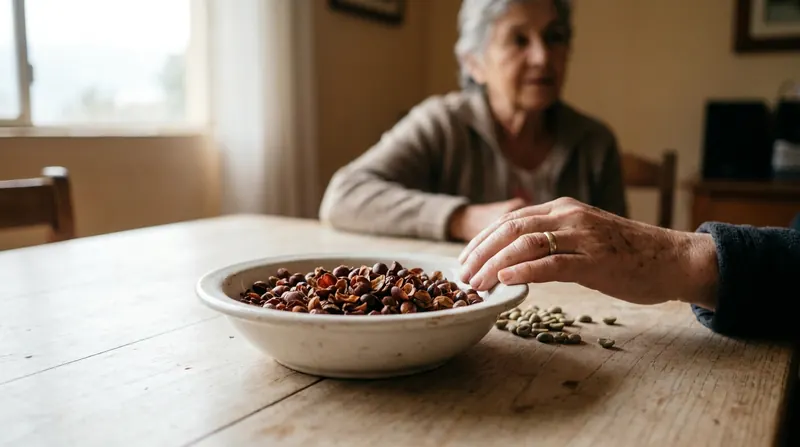
The pouch uses the whole fruit, dried and ground to a powder.
The label calls it coffee berry, and it names the plant: Coffea arabica, the same species as most of the coffee on a grocery shelf.
So the first thing to know about this ingredient is plain.
If you drink coffee in the morning, this is the fruit of the plant you already drink.
The second thing to know is that it brings caffeine.
The bag says so in its own words, calling coffee berry a source of caffeine, and it prints no number of milligrams.
I will come back to that number, or rather the missing number, in the next section.
First, what the research on coffee fruit actually looked at.
There is one study that nearly every coffee fruit product leans on.
It gave healthy adults a single dose of 100 milligrams of a concentrate made from the whole coffee fruit.
Ten people were in each group.
Over the next two hours, a marker in their blood called BDNF rose by about 143 percent from where it started. [1]
In the comparison groups, taking caffeine from green coffee or a grape seed extract, the same marker rose by about 31 percent.
The authors themselves asked for larger studies.
I want to be fair to that study, because it is often quoted as if it were more than it was.
It measured a substance in the blood, once, over two hours, in ten people per group.
It did not test anyone's memory.
It did not test anyone's attention, or follow anyone for a week, or use the whole fruit powder that goes into this pouch.
It is a starting point for researchers.
It is not a reason, on its own, for a man at his kitchen table to expect anything he could notice.
So the honest summary of the coffee fruit is this: it is the fruit of a plant you already know, it brings some caffeine, and its one well-known study measured a blood marker rather than a mind.
None of that is a knock on the fruit.
It is simply what the evidence is, and it is worth knowing before you pay for it.
What a Mug of Coffee Already Carries
Now the missing number.
The pouch contains caffeine from the coffee berry, and the label does not say how much.
The reason it matters is that you are going to put that caffeine into a cup that already has some.
If your cup is coffee, it may already have quite a lot.
The Food and Drug Administration puts a 12-ounce cup of brewed coffee at somewhere between 113 and 247 milligrams of caffeine. [2]
That is a wide range, because beans, roasts and brewing all differ.
The same agency cites 400 milligrams a day, about two to three of those 12-ounce cups, as an amount not generally associated with negative effects in most healthy adults. [2]
Europe's food agency reached a similar place: single doses up to 200 milligrams and daily intakes up to 400 raise no concerns for healthy adults, and caffeine in moderate amounts increases alertness. [3]

So think of it like this.
Your morning mug already carries a number you probably do not know, somewhere in a range that spans more than a hundred milligrams.
The pouch adds a second number you cannot know, because it is not printed.
It is almost certainly smaller than the mug's, since the whole scoop weighs 1.3 grams and is shared with two other ingredients.
But smaller is not zero.
And the FDA lists what too much can bring: a faster heartbeat, jitters, an upset stomach, a headache, and a poor night. [2]
One of the customers on the seller's own page says exactly this.
She gives the powder four stars, calls it a high-quality product, and says she gets the jitters after drinking it, which she puts down to the coffee berry.
I kept her review, and you will find it further down with the others.
She is the most useful reviewer on the page, because she tells you what to watch for.
If you are sensitive to caffeine, the coffee berry is the line on this panel to think about.
If you already drink three or four mugs a day, count the pouch as part of them.
And keep it in the morning cup.
The caffeine is real even though its number is missing, and the evening is the wrong time to add some.
At our table the rule is simple: anything with caffeine goes in before noon.
There is one more point about the coffee cup, and it is the one most people miss.
If you stir the pouch into coffee, the coffee itself is doing most of the work you will feel.
That is not a criticism of the pouch.
It is just arithmetic: a full mug of brewed coffee carries far more caffeine than any share of a 1.3-gram scoop could.
So a coffee drinker who adds the pouch and feels sharp at nine should ask a fair question.
How much of that sharpness was there yesterday, without the pouch?
I will give you a way to answer that honestly near the end.
It involves a notebook, and it takes a month.
The Leaf the Theanine Was Taken From

Now the tea caddy.
The second ingredient in the pouch is L-theanine, and the label says it comes from green tea.
L-theanine is an amino acid, one of the small building blocks of protein.
It is found almost only in the tea plant, and in a few mushrooms.
It is part of what gives green tea its savory, brothy taste.
If you have ever noticed that a good green tea tastes a little like broth, that is partly the theanine.
Here is something I did not know until I looked it up.
Green tea, black tea and oolong all come from the same plant, Camellia sinensis, and green tea also contains caffeine. [4]
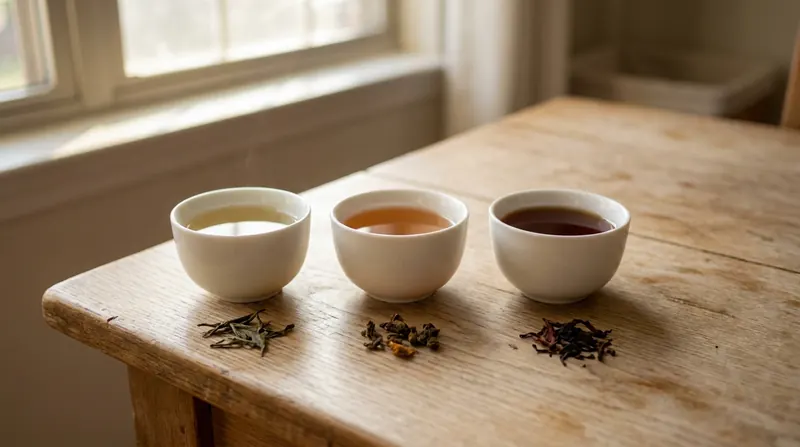
So the difference between the tea in my wife's cup and the tea in mine is not the plant.
It is what was done to the leaf after it was picked.
She has opinions about all of this, and most of them are about time.
A green tea left too long turns bitter, she says, and a black tea taken out too soon tastes of nothing.
Whatever the leaf carries, the cup only gets what the water pulls out of it.
So two cups of the same tea, brewed by two different people, are not quite the same cup.
I mention it because the pouch works the other way round.
The powder does not steep and is not strained; it goes into the cup whole, and whatever is in the half teaspoon stays in the half teaspoon.
That matters for the pouch, because it means a tea drinker already has theanine in the cup.
And a tea drinker already has some caffeine in the cup too.
The pouch's theanine is sold under the trade name L-TeaActive.
The panel does not print how much of it is in a half teaspoon.
What does the research on theanine say?
Two studies are worth your time, and neither tells you what a scoop of this pouch would do.
The first was done in Japan with men and women aged 50 to 69 whose mental-status scores were normal.
After a single dose of L-theanine, compared with a placebo, they had a faster reaction time on an attention task and made more correct answers and fewer omissions on a working-memory task. [5]
That is encouraging, and it is close to the age of the man reading this.
But the published summary does not give the dose, and the authors came from a tea company.
So there is no way to set that study beside a scoop of this pouch.
We know the direction of the result, not the amount that produced it.
The second study is clearer about its dose.
Thirty healthy adults, averaging 48 years old, took 200 milligrams of L-theanine a day for four weeks in one period and a placebo in another. [6]
After the theanine weeks, their scores on verbal fluency and on a test of planning and switching were better.
Against placebo, the verbal fluency gain showed up in the half of the group who started with the lower scores, and two of the authors worked for the company that supplied the theanine. [6]
Two studies, one without a dose and one at 200 milligrams a day, and a pouch that prints no theanine figure at all.
That is where theanine stands on its own.
But theanine almost never gets studied on its own, because it has a famous partner.
The Pairing That Was Measured, and the Pairing in the Pouch
If you read about theanine for more than ten minutes, you run into caffeine.
The two are studied together more than either is studied alone, because tea carries both.
The study most often cited is a small one, and it is worth describing exactly.
Twenty-seven healthy volunteers took, on different days, a placebo or a single dose of 50 milligrams of caffeine together with 100 milligrams of L-theanine. [7]
An hour later, on the pairing, they were faster and more accurate at switching attention back and forth, and less thrown by distractions during a memory task.
I will set the study out in full on a card further down, where the two cups meet.
Fifty milligrams of caffeine and a hundred of theanine.
Those are the only two numbers in this whole story that come from a study of the pairing.
Now look at the pouch.
It carries caffeine, from the coffee berry, and it carries theanine, from green tea.
It has both halves of the one pairing with a study behind it, and it prints a number for neither.
I find that the most interesting fact on the whole panel.
It means nobody can tell you whether a scoop gets anywhere near 50 and 100.
It might be above, it might be below, and it will also depend on what cup it goes into.

Which brings me to the thought that kept me at the table longer than I expected.
A plain cup of tea already carries both halves of that pairing.
Not at the study's numbers, and not at any number printed on a box.
But the leaf brings its own caffeine and its own theanine, together, as it has for as long as people have drunk it.
So a tea drinker who stirs this pouch into tea is adding more of two things the cup already has.
And a mushroom.
A coffee drinker who stirs it into coffee is adding a theanine the cup did not have, and a little more caffeine to a cup that has plenty.
And the same mushroom.
That is the real difference between the two cups, and it is why the answer to "coffee or tea?" matters more than the label lets on.
I do not think either is wrong.
But they are not the same purchase, and a man should know which one he is making.
The Only Stranger at the Table: A Mushroom Cooks Put in a Pan
Now the third ingredient, the one I did not have in my kitchen.
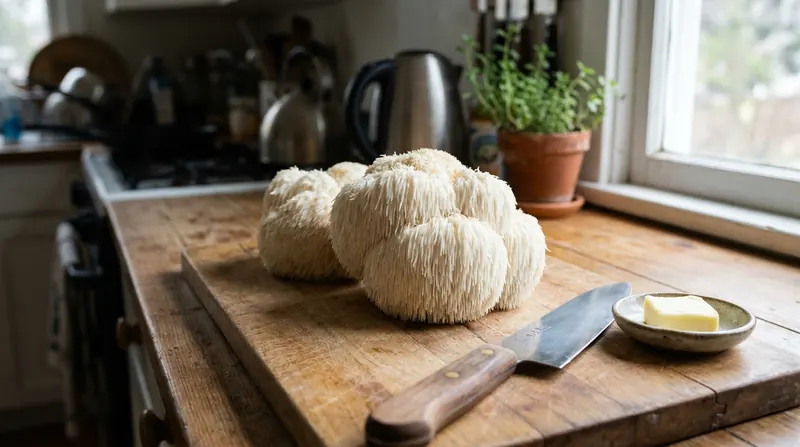
Lion's mane is a mushroom, and the first thing to know about it is that people eat it.
It grows on older beech and oak trees in forests across the northern half of the world.
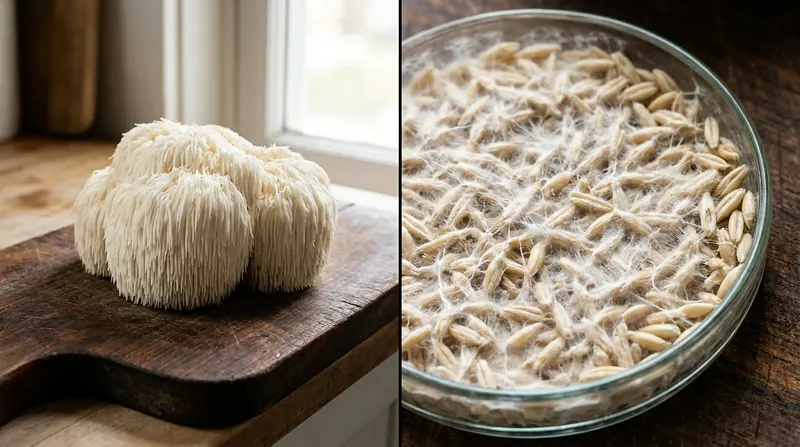
It looks like a white pom-pom, or a small frozen waterfall, with long soft spines hanging down.
In Japan it is called yamabushitake.
It has a long history as a food in East Asia, and it is eaten in the United States too, often sliced and browned in a pan.
Cooks compare its texture to crab or lobster.
I had it once at a restaurant in Portland, sliced thick and seared, and I would not have guessed it was a mushroom.

So the mushroom is not exotic in the way the word "mushrooms" on a supplement might suggest.
It is a food.
But the version in the pouch is not the slice in the pan.
The label says it is mycelium and fruiting bodies, grown on organic oats.
The fruiting body is the part you would recognize, the white pom-pom on the tree.
The mycelium is the fine web that grows through the wood, or here through a bed of grain, before any fruiting body appears.
When a mushroom is grown this way, the grain it grows through is dried and milled into the powder along with it.
So part of the lion's mane weight in the pouch is oat, and the bag does not say what part.
I will not dwell on the oat, because the bag is open about it.
I mention it only because it matters for the next comparison.
The research on lion's mane in people over fifty comes down to one small trial.
It was done in Japan, with thirty-one healthy adults over fifty, for twelve weeks. [8]
Half took a preparation of the fruiting body every day, and half took a placebo.
The lion's mane group scored higher than the placebo group on a standard short test of mental status. [8]
A second test in the same study, of visual memory, did not change.
And the amount they took was 3.2 grams a day, of fruiting body.
Three point two grams a day of fruiting body, against a scoop that weighs 1.3 grams for all three ingredients together.
Even if the whole scoop were mushroom, it would be well under half of that.
And the whole scoop is not mushroom, and part of the mushroom share is oat.
There is a second study, and it is sometimes quoted too.
Forty-one healthy adults aged 18 to 45 took a single 1.8-gram dose, and an hour later they were faster on a color-and-word task than on placebo. [9]
The same people then took it for twenty-eight days.
Over that month, nothing reached significance. [9]
So one small trial found a difference on one test out of two in older adults, at a dose far above this scoop.
And one small trial in younger adults found a single-dose difference that did not hold up over a month.
That is the honest record of the mushroom this pouch is named after, and it is thinner than the name on the front would lead you to think.
I say that without any grudge against the mushroom.
It is a good food, it has a long history, and researchers are right to keep looking at it.
But a half teaspoon of a three-ingredient blend is not what those researchers gave anyone.
Nobody has studied these three ingredients together, in any cup, in anyone.
One Mushroom, Two Parts of It, and a Plural on the Front
Before I moved on to the cups, I went back to the front of the bag.
It says Focus and Memory Mushrooms, plural.
The panel lists one mushroom.
Lion's mane, Hericium erinaceus, and nothing else from the mushroom family.
The plural, as far as I can tell, comes from the two parts of that one mushroom that are in the powder.
The label names both: mycelium and fruiting bodies.
I do not read anything sly into that.
Laird Superfood sells other mushroom blends with other names, and "mushrooms" is simply the family name for the line.
But it is worth knowing when you set the pouch beside its research.
The trial in adults over fifty used the fruiting body alone, and this pouch mixes it with mycelium and does not say in what share. [8]
The fruiting body is the part cooks buy.
The mycelium is the part that grows first, out of sight, through the wood or the grain.
Both are the same organism.
They are not the same material, and a study of one is not a study of the other.
So when I say the pouch holds well under the trial's amount, I mean it twice over.
Less than half the weight even if the scoop were all mushroom, and only part of that mushroom share is the part the trial used.
I do not know the split, and the company does not print it.
If you want it, the company answers the phone seven days a week, and it is a fair question to ask before you buy.
The front of the bag says what the line is called; the back of the bag says what is inside, and the back is the one to read.
So it is time to put the pouch itself on the table, between the tin and the caddy, the way my brother-in-law left it.
I have kept it back this long on purpose, because the plants behind it tell you more than the front of it does.
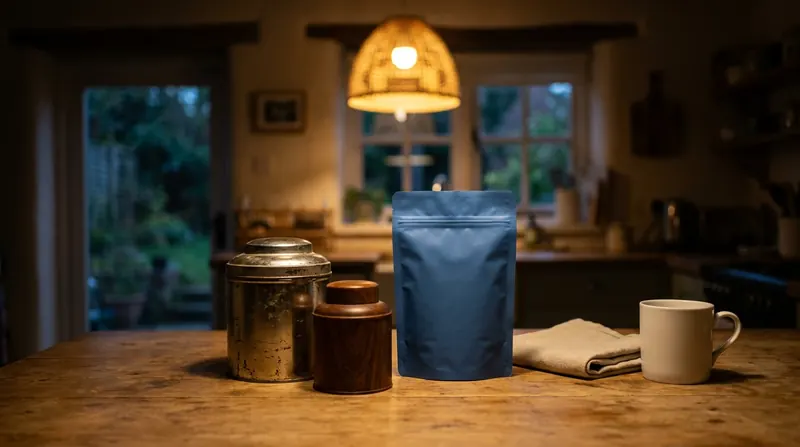
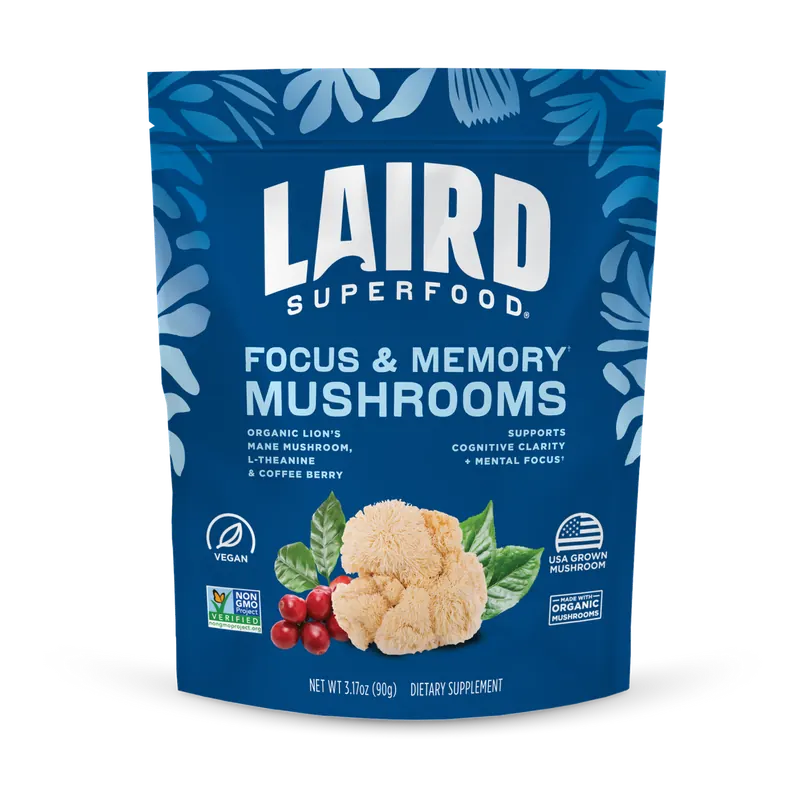
Focus and Memory Mushrooms is sold as a dietary supplement, not as a food or a drink.
It comes from Laird Superfood, Inc., a company that started in Sisters, Oregon, and its bag says it was manufactured for them.
The pouch weighs 3.17 ounces, which is 90 grams.
A serving is half a teaspoon, and the label says what that weighs: 1.3 grams.
That works out to about sixty-nine servings in the pouch.
Five calories a serving, and one gram of carbohydrate.
The bag says vegan, kosher, Non-GMO Project verified, and certified organic by Oregon Tilth.
It says the mushroom is grown in the United States, and it says there are no fillers.
That last line matters more than it sounds, and it comes back in a moment, at the stirring.
Before the cups, hold on to the one number that covers everything: 1.3 grams, three ingredients, no split printed.
Coffee Cup or Teacup: What the Half Teaspoon Adds to Each
Now the comparison my brother-in-law was really asking for.
I set out two cups on the evening table and wrote down what the half teaspoon changes in each.
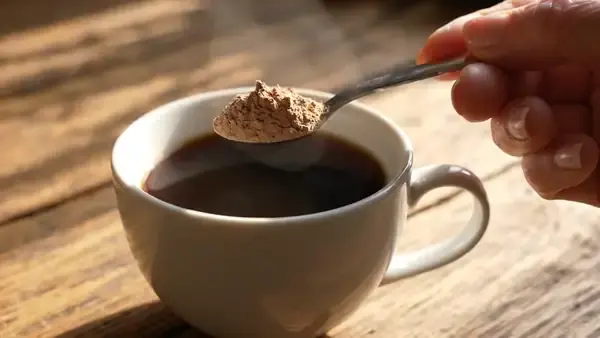
Start with the mug of coffee, because that is where most of these pouches go.
The coffee already brings a large and unknown amount of caffeine, somewhere in a range the FDA puts at 113 to 247 milligrams for twelve ounces. [2]
The half teaspoon adds four things.
Here they are, in the order of how sure I am about them.
- A little more caffeine, from the coffee fruit, in an amount the label does not print
- An amino acid from the tea leaf that black coffee does not normally carry
- Some lion's mane, as mycelium and fruiting body grown on oats, at well under the trial's 3.2 grams
- Five calories, one gram of carbohydrate, and a slightly earthy taste the coffee mostly covers
The theanine is the most interesting addition to a coffee cup.
It turns a mug of coffee into something closer to the caffeine-and-theanine pairing the small study looked at. [7]
Here is that study once more, on one card, because this is the point where it matters most.
Closer, not the same.
The coffee's caffeine is probably well above 50 milligrams, and the theanine figure is unknown.
Now the cup of tea.
The tea already brings caffeine and theanine together, both from the leaf, and the amounts vary with the tea and how long it steeps.
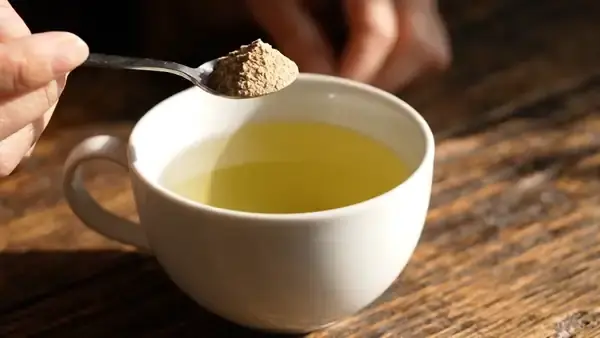
In a teacup, the half teaspoon adds these.
- More theanine, in a cup that already has its own
- Some caffeine from the coffee fruit, which a cup of green tea did not have before, on top of the leaf's own
- The same lion's mane, at the same fraction of the trial's amount
- A little cloudiness, and a taste that tea covers less well than coffee does
So in coffee, the pouch mostly adds the tea's half of the pairing.
In tea, it mostly adds a coffee fruit and more of what was already there.
In both, the mushroom is the one thing you did not have before.
And in both, it is the ingredient whose research is furthest from the amount in the scoop.
In other words, the pouch does something different in each cup, and the mushroom does roughly the same small thing in both.
If you drink only coffee, the pouch is the easiest way I know to add theanine to a cup that lacks it.
That is a fair reason to buy it, as long as you know the theanine figure is not printed.
If you drink mostly tea, ask what the pouch adds that your cup does not already carry.
The honest answer is some coffee fruit with its caffeine, and a small amount of a mushroom.
And if you drink smoothies, as the label also suggests, then the whole caffeine question starts from zero.
The half teaspoon brings the only caffeine in the glass, in an amount nobody has printed.
None of this makes the pouch good or bad.
It makes it three different purchases, depending on your cup.
Half a Teaspoon, Levelled, and Stirred as You Sip
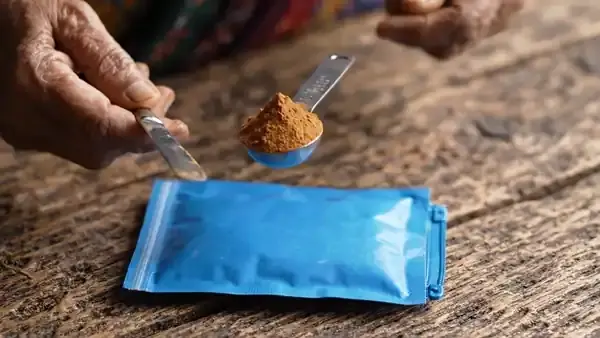
The label's direction is short.
"Add a half teaspoon scoop to your daily drink of choice. Mix well, and give it a stir or shake as you sip."
Half a teaspoon is a small measure.
It is the kind of amount a recipe calls for when it wants a little salt, not a spoonful of anything.
The pouch my brother-in-law left came with a scoop inside.
If yours does not, a kitchen half-teaspoon does the same job.
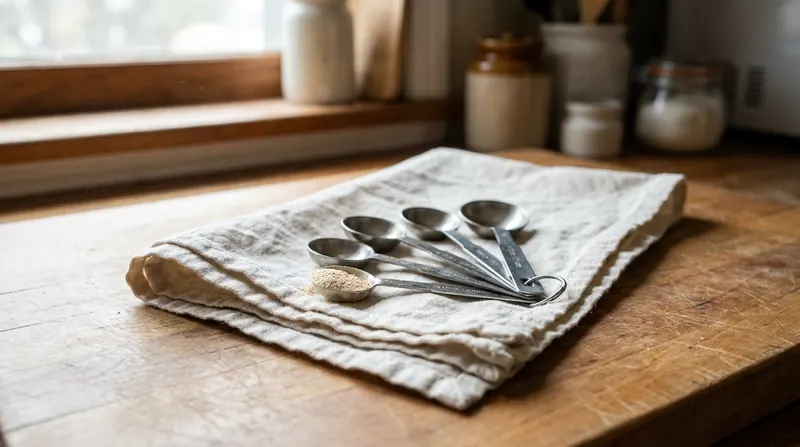
Level it.
A heaped half teaspoon can easily be half again as much, and there is no reason to guess high on a powder with caffeine in it.
Then comes the part the bag is honest about.
It says there are no fillers, and it says that if you see sediment, that is fine: just mix as you drink.
No fillers means nothing was added to help the powder dissolve or flow.
So some of it will not dissolve, and it will settle at the bottom of the cup if you let it sit.
That is why the label says stir or shake as you sip, not just when you pour.
In a mug of coffee, a stir every few minutes is enough.
In a cup of tea, the cloudiness shows more, and so does the settling.
Tea drinkers who like a clear cup may prefer the coffee.
In a smoothie, a blender takes care of it entirely.
That is the one drink where the no-filler powder behaves best.
Hot or cold does not seem to matter much to the directions.
The label says only "your daily drink of choice," and I would take that at its word.
The gesture, in the end, is small: level the half teaspoon, tip it in, and stir it again halfway down the cup.
Three Old Habits in One Spoon
Reading about the three ingredients, I kept noticing how old each of them is as a habit.
None of them is new; only the combination is.
The coffee fruit was steeped as cascara in Yemen and Bolivia long before anyone put it in a pouch.
People there drank the husk the rest of the world threw away.
Theanine has been in every cup of tea ever poured.
It was only picked out and given a name in Japan in 1949, but tea drinkers had been drinking it for centuries without knowing.
And lion's mane has a long history as a food in East Asia and in Native American traditions.
In Japan it has its own name, and in China another.
So the pouch is three old habits, dried, ground and put into one spoon.
What is new is the spoon, not the plants.
I find that reassuring in one way.
These are not strange substances from a laboratory; they are a fruit, a tea compound and a food mushroom.
And I find it a useful reminder in another.
Something being old and ordinary tells you it is familiar; it does not tell you what a half teaspoon of it will do for your mornings.
For that you need a study at the amount in the spoon, and for this spoon there is none.
You need your own notebook instead, and that is the next thing, after one more stop at the table.
The Plate Under the Lamp
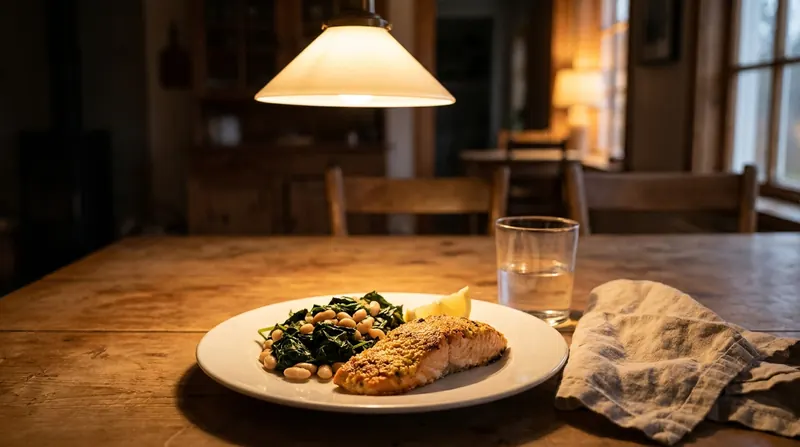
I promised you something from the evening table that was not in the pouch.
Here it is.
While I was reading about the three ingredients, I kept running into a larger study about the plate itself.
It is the kind of study that deserves more attention than any powder.
Researchers took 604 older adults with normal thinking, all of them carrying some extra weight and eating a less-than-ideal diet.
For three years, half followed the MIND pattern, heavy in leafy greens, berries, beans, nuts, whole grains, olive oil and fish, and half followed their usual diet with a small cut in calories. [10]
Both groups improved on tests of thinking over those three years.
And they improved by about the same amount. [10]
I read that twice.
The group eating the celebrated pattern did no better than the group that simply ate a little less, with advice and support.
You can read that as disappointing.
I read it as freeing, because it means no single food, and no single spoonful, was the thing that mattered.
What mattered, as far as anyone can tell, was the whole table, kept up for years, with somebody paying attention to it.
That is exactly the kind of thing a pouch cannot do for you.

There is a second small study I keep near the kettle.
In Berlin, 1,111 adults aged 60 to 89 were measured for how well-watered they actually were. [11]
The third who were measurably short of water slipped faster over time on a test of processing speed than the others. [11]
That was an observation, not an experiment, but a glass of water costs nothing.

So when my brother-in-law asks about the pouch, I will tell him about the cups.
But I will also tell him about the plate and the glass, because they come first.
A pouch goes on top of a table.
It does not replace one.
Six Customers, Six Cups
The seller's page carries reviews, collected through its own review system.
When this desk read them in September, there were 68, averaging 4.68 stars, and 65 were marked as confirmed purchases.
I read all of them.
I set aside the ones that talked about things the label does not claim, the ones about digestion or appetite, and the ones that had not formed an opinion yet.
I also set aside one five-star review that I liked, for a reason of wording that has nothing to do with the customer.
That left six, and I kept two lukewarm ones on purpose.
What I noticed first is how many of them mention the cup.
Nearly everyone who says where they put it says coffee.

I blend this with my morning coffee. It gives me a pick up and gets the day started more clear and focus. Especially when sitting down to pay the monthly bills!

Super easy to use. So delicious in my coffee. Truly makes me feel like I'm getting my day off to a great start!

It isn't bad and I put it in my coffee. Can I see anything memory and focus? Not really. I will know more when I am done with the bag.

High quality product, however I get the jitters! Taste is the same to me, however I get the jitters after drinking. I attribute this to the Coffee Berry ingredient.

Has certainly helped with focus during the day. Have been feeling great since incorporating.

I feel more clear in my thoughts daily after only 1 week of use.
Martha's review is the one I would frame.
Morning coffee, a pick-up, and the monthly bills: that is a real kitchen table, and a real morning.
Jennifer's is the most honest.
She puts it in her coffee, she cannot say she has seen anything for memory or focus, and she is waiting until the bag is done to decide.
Angela's is the most useful, as I said earlier.
She names the coffee berry, and she names the jitters.
And Kimberly, Kyle and Daryl describe a better start to the day.
Every one of those good mornings came with a cup of coffee in it, and the coffee deserves some of the credit.
That is not me doubting them.
It is me saying that a review of a powder stirred into coffee is partly a review of the coffee.
These are six people's experiences in their own words.
They are not a study, and results differ from one person to the next.
What Half a Teaspoon Will Not Do
It is worth being plain about the other side, so nobody buys the pouch expecting the wrong thing.
- It will not bring you the lion's mane amount of the trial in adults over fifty. That was 3.2 grams a day of fruiting body, and this whole scoop is 1.3 grams of three ingredients.
- It will not tell you how much caffeine you are adding. The label does not print it.
- It will not tell you how much theanine you are adding either, which means nobody can match it to the study of the pairing.
- It will not undo a short night, a skipped supper, or a day without water.
- It will not stand in for anything a clinician has given you, and it is not meant for any medical condition.
- It will not work the same way in every cup, because coffee, tea and a smoothie start from different places.
And one more, which is really a caution.
The bag says the powder is not intended for anyone under 18, and it asks anyone who is pregnant or nursing, has a health condition or takes anything daily to talk with a licensed healthcare provider first.
I would add one line of my own.
If you take anything daily and you are about to add caffeine you cannot measure, ask your pharmacist whether that combination is a good fit for you.
A Fair Test at Your Own Table
If you do decide to buy a pouch, I would ask you to test it fairly.
It costs nothing extra, and it is the only way to know whether it is doing anything for you.

The test has four parts, and none of them is complicated.
One cup.
Pick the cup you already drink every day, coffee or tea, and put the pouch only in that one.
One time.
Drink it at the same hour each morning, and keep everything else about that cup the same: the same mug, the same amount, the same strength.
One line.
Keep a small notebook by the cup, and every day at the same hour write one line about the morning: how the first job of the day went, whether a name came easily, whether you felt the jitters.
One week without.
Before you open the pouch, write your one line for seven mornings with your usual cup and nothing added.
That week without is the part everyone skips, and it is the part that matters most.
Without it, you have nothing to compare the pouch against except your hopes.
Then use the pouch for three weeks, still writing your line.
At the end, read the notebook from the start.
Keep the lines short, and keep them about ordinary things.
Something like "Bills done before nine, no trouble," or "Couldn't find the word for the neighbor's dog, came back at lunch," or "Jittery by ten."
Do not score yourself out of ten, and do not write what you hope to see.
Write what happened, in the plainest words you have, and move on with your morning.
If you drink coffee and tea both, as I do, pick one for the test and leave the other alone.
Changing two cups at once tells you nothing about either.
If the pages from the pouch weeks look different from the week without, you will see it. If they look the same, you will see that too.
There is a time limit to keep in mind.
The seller's promise runs thirty days from the day the pouch reaches your house.
So start the week without while you wait for the delivery.
Open the pouch the day it arrives, and you will have your answer with about a week to spare.
And be honest about the cup.
If you feel sharper, ask yourself whether the coffee was doing that before, because the notebook's first week will tell you.
Who Might Want It in the Cupboard, and Who Should Leave It Out
After a week at the evening table, here is where I came down.
It suits a man who drinks coffee and wants to add theanine without changing his habit.
That is the clearest case for the pouch: it puts the tea's half of the studied pairing into a cup that lacked it.
It suits a man who likes the idea of lion's mane and is content with a small daily amount.
As long as he knows the trial used far more, and that part of the mushroom weight is oat.
It suits a man who wants a clean label.
Three ingredients, no sweetener, no filler, organic, and one company he can call on the phone.
It is a poorer fit for a man who drinks mostly tea.
His cup already carries caffeine and theanine together, and the pouch mostly adds more of the same, plus a coffee fruit.
It is a poor fit for anyone who is sensitive to caffeine.
The amount is not printed, and one reviewer's jitters are a fair reminder.
It is a poor fit for anyone who wants to know exactly how much of each ingredient he is taking.
That number does not exist outside the company.
And it is not for anyone under 18, anyone pregnant or nursing without a word from their provider, or anyone expecting it to do the work of a clinician.
That last group is the one I most want to reach.
From Sisters, Oregon, to the Kitchen Table
Laird Superfood started in Sisters, Oregon, a small town on the dry side of the Cascades.
Its privacy policy gives a post office box there, and the bag says it was manufactured for the company at an address in Boulder, Colorado.
The company can be reached by phone at (888) 670-6796, from 8 a.m. to 4 p.m. Pacific time, seven days a week.
It also takes text messages at (541) 588-3600, and email at aloha@lairdsuperfood.com.
I like a seller who can be called on a Sunday.
That is not common, and it matters if something goes wrong.
"Manufactured for" is an ordinary phrase on food and supplement labels.
It means the company that sells the product had someone else make it to its order, which is how most small brands work.
It also means the name on the front and the address on the back are not always the same place.
Here the company is in Oregon, the making happened for them at an address in Colorado, and the mushroom, the bag says, was grown in the United States.
None of that should put you off.
It is simply worth knowing who you are dealing with, and here the answer is one company with a phone line and a name you can look up.
The product page says orders are normally sent out the same day.
Standard shipping inside the United States costs nothing on a first order, and on one-time orders above the seller's minimum.
The return promise is thirty days, counted from the time the pouch reaches your home, not from the day you order.
You write or call, and the company offers a replacement, an exchange or a refund if it cannot otherwise help.
Thirty days is shorter than the pouch.
At half a teaspoon a day, sixty-nine servings is more than two months, so you decide with most of the powder still in the pouch.
I will not print a price, because the seller sets it and it changes.
Look at it, and at the shipping line for your address, before you order.
Every ingredient printed on the pouch, what each one is, what the research does and does not say about it, and the cautions that go with it are written out in the ingredient guide linked at the foot of this page.
That guide also carries the references in full and the disclosures this page is required to make.
One pouch, about sixty-nine cups of coffee or tea
Half a teaspoon of mushroom, tea amino acid and coffee fruit stirred into the cup you already drink every morning, from a company in Oregon.
SEE THE POUCH FOR YOUR CUPSold by Laird Superfood, Inc., Sisters, Oregon · 3.17 oz (90 g), half a teaspoon a serving · contains caffeine from coffee berry, amount not printed · standard shipping at no charge on a first order · 30 days from the day it arrives
What people ask me across the table about the pouch
Is this medicine?
No. It is a dietary supplement from Laird Superfood, Inc., and it is not meant for any medical condition.
Coffee or tea?
Either, as the label says. In coffee it mostly adds the tea's amino acid; in tea it mostly adds coffee fruit and more of what the leaf already carries.
How much lion's mane is in a scoop?
Nobody outside the company can say. The panel prints 1.3 grams for all three ingredients together, and part of the mushroom weight is oat.
How much caffeine does it add?
The label does not print it. Count it with your coffee, and keep it to the morning cup.
How much theanine is in it?
That is not printed either. The one study of the pairing used 100 milligrams of theanine with 50 of caffeine. [7]
Why does it leave sediment?
The bag says there are no fillers, so some of the powder settles. Stir it again as you drink.
How long does a pouch last?
About sixty-nine servings at half a teaspoon a day, which is a little over two months.
What if I do not like it?
The seller gives thirty days from the day it arrives. Call (888) 670-6796 or write to aloha@lairdsuperfood.com.
The Table, Cleared: Everything Above in Short
Two of the three ingredients in Focus and Memory Mushrooms come from plants already in most kitchens: the fruit of the coffee plant and an amino acid of the tea leaf.
The third, lion's mane, is an edible mushroom grown here on oats, and it is the only real newcomer.
The panel prints one number, 1.3 grams, for all three together.
Nobody outside the company knows how much of each is in a scoop.
The coffee fruit brings caffeine the label does not quantify, and its best-known study measured a blood marker in ten people per group. [1]
The theanine has two small studies behind it, one without a dose and one at 200 milligrams a day. [5] [6]
The pouch carries both halves of the one pairing with a study at fixed amounts, 50 milligrams of caffeine with 100 of theanine, and prints a number for neither. [7]
The lion's mane trial in adults over fifty used 3.2 grams a day of fruiting body, far more than any scoop could hold. [8]
In coffee, the pouch mostly adds theanine.
In tea, it mostly adds coffee fruit and more of what the cup already has.
Test it with one cup, one time, one line a day, and a week without first.
Keep it to the morning, count its caffeine with your coffee, and remember that the plate and the glass of water matter more. [10]
What I Told My Brother-in-Law
He called again on Sunday to ask what I had decided.
I told him the answer to his question was coffee.
Not because the pouch works better in coffee.
Because in coffee it adds something the cup did not have, and in his tea it mostly adds more of what the leaf already brings.
Then I told him the rest.
That the mushroom is a good food, but that a half teaspoon is not what its one trial used.
That the caffeine is real and unprinted, so he should count it and keep it to the morning.
And that the most useful thing I found all week was a study about supper plates.
He laughed at that.
But he said he would start the week without on Monday, with a notebook by the mug.
That is the whole of my advice, and it fits on a napkin: know your cup, count your caffeine, and write one line a day.
The pouch is honest about what is in it, even if it does not say how much.
The company answers the phone seven days a week, and it gives you thirty days from the day the pouch arrives.
If that sounds like a fair trade for your cup, the pouch is below.
If it does not, keep your coffee and your tea just as they are, and eat a good supper.
From the company in Sisters, for the cup already on your table
Half a teaspoon of mushroom, tea amino acid and coffee fruit stirred into the cup you already drink every morning, from a company in Oregon.
SEE THE POUCH FOR YOUR CUPLaird Superfood, Inc. · (888) 670-6796, 8 a.m. to 4 p.m. Pacific, seven days · half a teaspoon in coffee, tea or a smoothie · caffeine from coffee berry, amount not printed · 30 days from the day it arrives